What Is a Setlist? Definition, Examples, and How Bands Build One
July 28, 2026
· The Music Planner Team
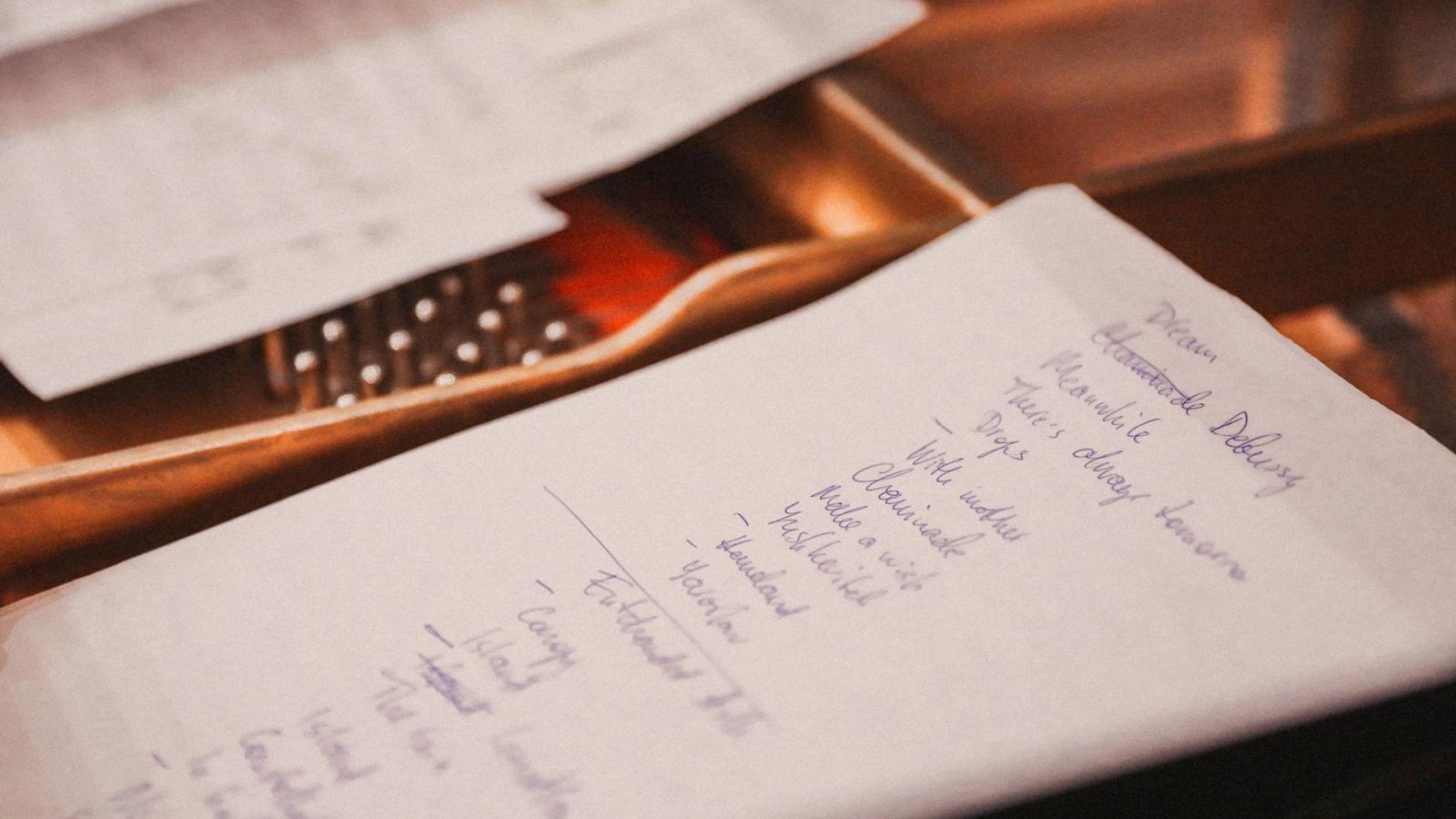
A setlist (also written "set list") is the ordered list of songs a band or artist plans to perform at a show. It covers one set - a continuous block of playing - and a good one carries more than song titles: keys, tempos, who counts each song in, and notes about transitions or endings. Bands tape them to the stage floor, clip them to mic stands, or read them from a tablet.
That's the short answer. Here's the longer one - what actually goes on a setlist, how it differs from your repertoire, and how working bands put one together.
What's actually on a setlist
A setlist for the audience is just song names. A setlist for the band usually includes:
- Song order - the core of it. Openers, peaks, breathers, and the closer, in sequence.
- Keys - essential when songs are transposed for a singer, or when players need to grab a capo or switch instruments.
- Starting cues - who counts it in, or which instrument opens.
- Tempos - a BPM note keeps the drummer honest when adrenaline kicks in.
- Transition notes - "straight into the next one", "pause for band intros", "key change on the last chorus".
- Backup songs - one or two extras at the bottom in case the set runs short or the crowd wants more.
Is it "setlist" or "set list"?
Both are correct. "Set list" is the older two-word form and still appears in dictionaries; "setlist" as one word is what most musicians, venues, and fan communities actually write. Use whichever you like - just be consistent. (This article uses "setlist" because that's how bands say it.)
Setlist vs. repertoire (and other terms that get mixed up)
- Repertoire - every song your band *can* play. A working covers band might have 150 songs in its repertoire.
- Setlist - the songs you *will* play tonight, in order. Maybe 25 of those 150.
- Set - one continuous block of performance. A pub gig might be two 45-minute sets with a break; each set has its own list.
- Running order - at festivals and multi-band nights, the schedule of which act plays when. Same idea, one level up.
How different bands use setlists
The setlist plays a different role depending on the gig:
- Wedding and function bands live and die by them. Dinner sets, dance sets, the first-dance song at an exact time - the setlist is effectively the event's schedule.
- Cover bands build them to read the room, and often reshuffle mid-set when a song lands (or doesn't).
- Original artists use them for pacing - spreading singles across the night, sequencing album material, planning the encore.
- Worship teams plan around keys and flow, so songs move smoothly and the congregation can actually sing along.
- Tribute acts often recreate the exact setlist from a famous tour, song for song.
A real example
Here's what a first set might look like for a four-piece covers band playing a bar gig:
- Hard to Handle - B - drums count in
- Valerie - Eb - straight in from 1
- Superstition - Eb - watch the ending, cold stop
- Dreams - F - breather, singer talks first
- Signed, Sealed, Delivered - F
- Uptown Funk - Dm - stretch the outro if the floor is full
- Mr. Brightside - Db - closer
- (backup: Take Me Out - E)
Seven songs, keys on every line, and three notes that prevent three trainwrecks. That's a setlist doing its job.
How bands build a good setlist
The short version of the process:
- Start from the room, not your favorites - a Friday bar crowd, a wedding, and a listening-room audience need different sets.
- Shape the energy - open strong, build waves rather than one long climb, and save a genuine peak for the end.
- Check the seams - keys, tempos, and instrument changes between adjacent songs are where sets stumble.
- Plan the talking - decide where the band breathes and where it barrels ahead.
That's a whole craft of its own - we wrote a full step-by-step guide in How to Build the Perfect Setlist
Paper or digital?
The taped-to-the-floor paper setlist is a stage tradition, and for a one-off gig it works fine. It falls apart when things change: the singer swaps two songs at soundcheck, and now five printouts are wrong in five different ways.
A shared digital setlist fixes exactly that - everyone sees the same version, every song carries its key and charts, and a last-minute change reaches the whole band instantly. That's how Music Planner handles it: drag-and-drop setlists where each song brings its key, files, and practice tracks along with it, free to start.
Frequently asked questions
How many songs go on a setlist?
Rule of thumb: 10 to 12 songs per 45-minute set, assuming average 4-minute songs and a little talking. A three-hour wedding gig usually means three sets and 30 to 40 songs. Always list a couple of backups.
Do bands play the same setlist every night?
Some do, especially theatrical shows built around production cues. Most working bands keep a core skeleton and rotate songs around it - same opener and closer, different middle.
Who writes the setlist?
Usually the bandleader or lead singer drafts it, and the band adjusts it in rehearsal. The best process is collaborative: the drummer knows which transitions work, and the singer knows where their voice needs a break.
Where can I see famous artists' setlists?
Fan-maintained archives like setlist.fm document what artists played on past tours - useful for tribute acts, or for stealing sequencing ideas from acts who play 200 nights a year.